logo
Clinical Practitioners
Biomedical Researchers & Scientists
Medical Students & Academic Educators
Professionals in Pharmaceutical Companies
How to Search
How it Works
Search Now
Home>Biomedical Insights>
What Does BID Mean in Medical Abbreviations?

What Does BID Mean in Medical Abbreviations?

Written by Connor Wood
December 31, 2025

bid medical abbreviations

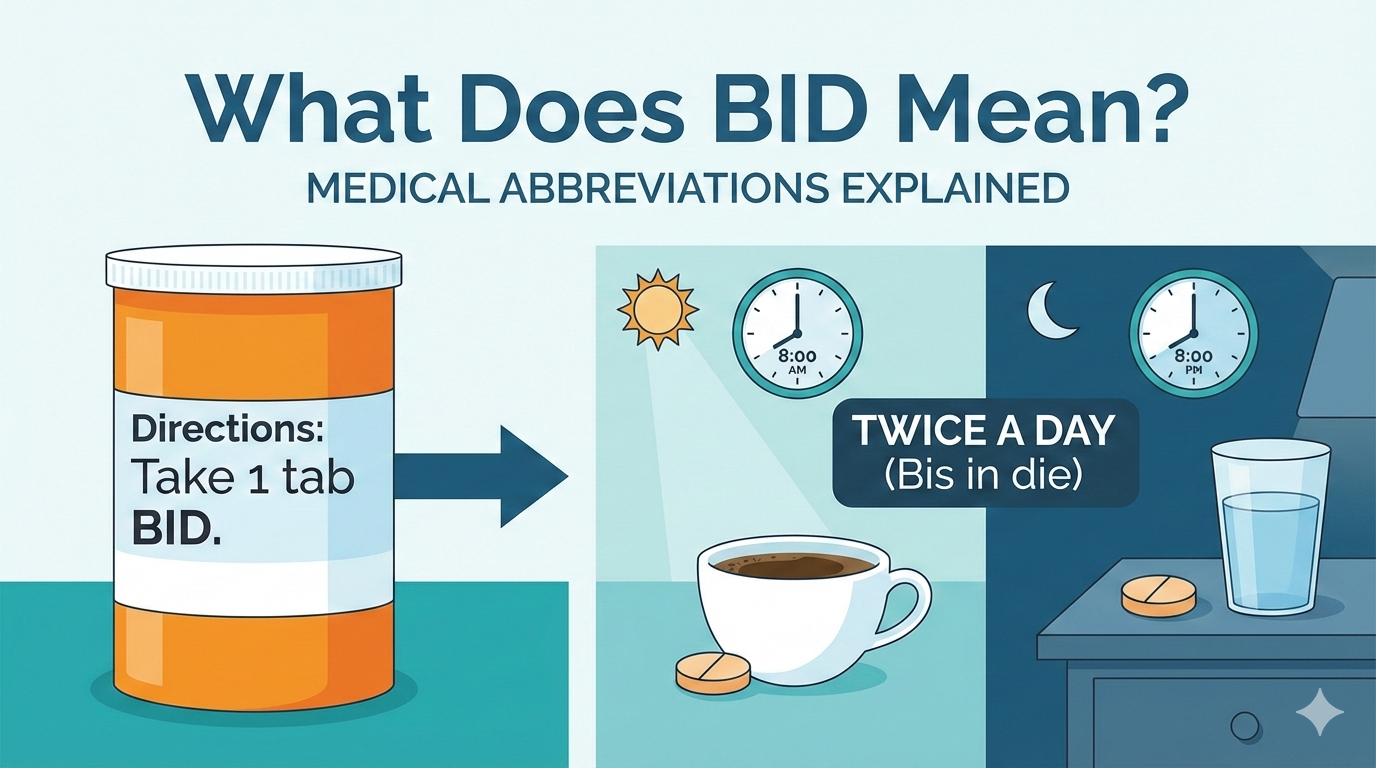
BID is a medical abbreviation meaning “twice daily,” indicating that a medication should be administered two times within a 24-hour period.
For medical students and researchers who want to confirm how BID dosing is defined, applied, and studied across clinical contexts, PubMed.ai offers an efficient way to search, summarize, and interpret peer-reviewed biomedical literature, supporting evidence-based understanding from first principles to advanced research.

For a deeper, easy‑to‑understand explanation of common medical abbreviations like BID, see ​PubMed.ai’s Common Medical Abbreviations Guide​.

What Does BID Mean in Medical Terminology?

BID means “twice a day” and is used to specify medication dosing frequency.
In clinical documentation, BID instructs that a drug be taken or administered two times within one day. The definition itself is fixed and widely standardized, but its application depends on clinical context, including the drug’s pharmacokinetics, indication, and patient factors. The National Institutes of Health (NIH) define BID as a common dosing abbreviation used across prescriptions, treatment guidelines, and research protocols.

What Is the Full Form and Linguistic Origin of BID?

The full form of BID is ​bis in die​, a Latin phrase meaning “two times in a day.”
Latin abbreviations have historically served as a concise professional language shared across medical disciplines and geographic regions. Although modern safety initiatives encourage plain-language instructions, BID remains deeply embedded in clinical and academic practice.

Understanding this Latin origin also supports correct interpretation of related abbreviations such as TID (​ter in die​) and QID (​quater in die​), which frequently appear alongside BID in pharmacology education and research literature.

How Is BID Used on a Prescription?

On a prescription, BID indicates that the medication should be taken twice daily.
It is often paired with qualifiers that clarify route of administration or relationship to meals, which can significantly affect drug performance.

Common examples include:

  • PO BID – by mouth, twice daily
  • BID AC – twice daily before meals
  • BID PC – twice daily after meals

According to ​RxList, these additions are clinically meaningful, as food intake and administration route can alter absorption rates, peak plasma levels, and adverse effect profiles.

Does BID Mean Exactly Every 12 Hours?

BID often implies, but does not strictly require, 12-hour dosing intervals.
In controlled research settings, BID dosing is frequently designed to approximate equal spacing to maintain stable drug concentrations. In routine clinical practice, however, BID may be operationalized as “morning and evening,” prioritizing patient adherence over precise timing.

Pharmacokinetic analyses available through PubMed show that for medications with narrow therapeutic windows, uneven BID timing can increase variability in drug exposure, highlighting why clarification is sometimes necessary.

How Is BID Interpreted in Pharmacy Practice?

In pharmacy practice, BID is interpreted within a framework of safety, efficacy, and patient behavior.
Pharmacists evaluate BID instructions by considering:

  • Drug half-life
  • Therapeutic index
  • Food–drug interactions
  • Patient lifestyle and adherence risks

The Institute for Safe Medication Practices identifies dosing abbreviations, including BID, as potential sources of error if not clearly communicated, reinforcing the pharmacist’s role in patient counseling and clarification.

What Is the Difference Between BID, TID, and QID?

BID, TID, and QID differ by the number of daily doses and their implied intervals.

AbbreviationMeaningTypical Interval
BIDTwice daily~12 hours
TIDThree times daily~8 hours
QIDFour times daily~6 hours

Clinical adherence research indexed in PubMed demonstrates that adherence declines as dosing frequency increases, a finding with direct implications for drug development, prescribing decisions, and trial design.

Is BID the Same as Once Daily Dosing?

BID is not equivalent to once daily dosing.
Once-daily regimens are typically abbreviated as QD or OD. Confusing these terms can lead to underdosing or overdosing, with measurable clinical consequences.

The Joint Commission includes several dosing abbreviations on its safety guidance due to the risk of misinterpretation, underscoring the importance of precision in medication orders.

How Do Meals Affect BID Medication Instructions?

Meal timing can significantly modify the effectiveness and tolerability of BID medications.
Instructions such as:

  • BID AC (before meals)
  • BID PC (after meals)

are used to manage absorption kinetics or reduce gastrointestinal adverse effects. Educational resources from MedlinePlus emphasize that disregarding these modifiers can compromise therapeutic outcomes.

How Is BID Pronounced in Clinical and Academic Settings?

BID is typically pronounced as “B-I-D” in professional communication.
Although the phonetic pronunciation “bid” is sometimes heard informally, spelling out the letters reduces ambiguity during verbal orders, clinical teaching, and interdisciplinary handoffs.

Why Is BID Important in Medical Research and Education?

BID is foundational to dosing strategy, study design, and outcome interpretation.
In clinical research, BID regimens influence:

  • Drug exposure curves
  • Adherence metrics
  • Comparative effectiveness analyses

Medical students encounter BID early in training, while researchers routinely evaluate BID dosing when analyzing trial protocols or conducting systematic reviews. Accurate interpretation is therefore essential across the educational and research continuum.

Key Points for Review

  • BID means twice daily
  • Derived from Latin bis in die
  • Timing and meal context influence outcomes
  • BID differs clearly from TID, QID, and once-daily dosing
  • Misinterpretation can contribute to medication errors

Although BID appears simple, its clinical and research implications are extensively examined across the biomedical literature.

Discover Medical Terms Effortlessly with PubMed.ai

If you want to understand, summarize, and explore biomedical terminology quickly, PubMed.ai is an essential educational tool. From clarifying abbreviations like BID to generating concise overviews of scientific concepts, PubMed.ai helps ​students, educators, and curious learners save time while enhancing comprehension​. Learn more at ​PubMed.ai​.

Frequently Asked Questions (FAQ)

What does BID mean in medical abbreviations?

BID means “twice daily.”
It is a standard medical abbreviation used to indicate that an action—most commonly taking a medication—should occur two times within a 24-hour period.

What is the full form of BID in medicine?

The full form of BID is ​bis in die​.
This Latin phrase translates to “two times in a day” and forms the basis for many traditional medical frequency abbreviations.

Is BID the same as every 12 hours?

No, BID does not always mean exactly every 12 hours.
While evenly spaced dosing is often implied in academic or pharmacological discussions, BID generally indicates frequency rather than a precise clock-based schedule.

How is BID different from TID and QID?

BID, TID, and QID differ by the number of times an action occurs per day.
BID means twice daily, TID means three times daily, and QID means four times daily. These distinctions are essential when interpreting medical texts or case studies.

What does BID AC or BID PC mean?

BID AC means twice daily before meals, and BID PC means twice daily after meals.
These modifiers clarify how timing relative to food should be understood in educational and clinical documentation.

Is BID the same as once daily?

No, BID is not the same as once daily.
Once-daily frequency is usually indicated by QD or OD, whereas BID always refers to two occurrences within one day.

How is BID usually pronounced?

BID is typically pronounced as “B-I-D.”
Spelling out the letters is preferred in academic and professional settings to avoid ambiguity.

Why is BID important for medical students and researchers?

BID is foundational for accurately interpreting medical literature.
It appears frequently in textbooks, exams, research articles, and case discussions, making correct understanding essential for academic accuracy and clear communication.

Disclaimer:
This AI-assisted content is intended for academic reference and informational purposes only and does not constitute medical advice, diagnosis, or treatment. Always consult qualified healthcare professionals regarding any medical condition or treatment decisions. All risks arising from reliance on this content are borne by the user, and the publisher assumes no responsibility for any decisions or actions taken.