What Is MEDLINE?
MEDLINE is a large, curated bibliographic database of references and abstracts from peer-reviewed journals in biomedicine and the life sciences. It is created and maintained by the U.S. National Library of Medicine (NLM), a part of the National Institutes of Health (NIH), and is designed to help users systematically discover and explore biomedical research literature rather than provide medical guidance or clinical recommendations.
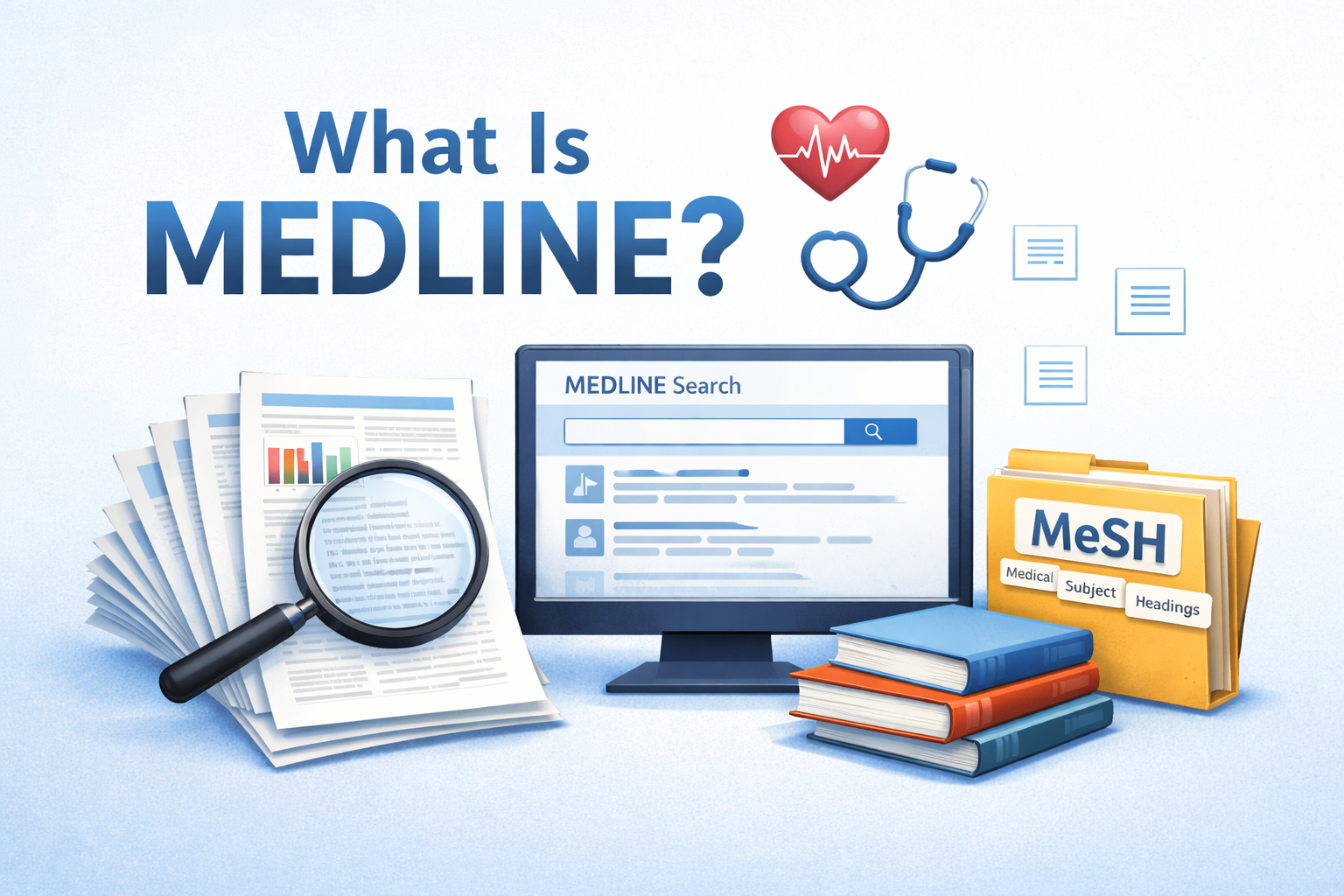
In practice, MEDLINE functions as a structured map of the global biomedical research record, organizing millions of scientific articles so they can be searched, compared, and studied efficiently.
If you want to quickly search, summarize, and organize biomedical literature, PubMed.ai is an invaluable tool. From extracting key study insights to generating structured research reports, PubMed.ai helps clinicians, researchers, and students save time while maintaining accuracy. Learn more at PubMed.ai.
Why Is MEDLINE Important in Scientific Studies?
MEDLINE is widely discussed in scientific and academic contexts because it supports evidence discovery and research transparency. Many studies and reviews rely on MEDLINE as a primary source when surveying existing knowledge in a field.
From a research-literacy perspective, MEDLINE matters because it:
- Provides systematic access to peer-reviewed biomedical literature, as described in PubMed’s database overview
- Helps reduce ambiguity by applying consistent indexing across journals, disciplines, and publication years
- Serves as a foundational data source for literature reviews, bibliometric analyses, and other secondary research methods
Rather than offering conclusions itself, MEDLINE enables researchers to examine how evidence has been generated, discussed, and revised over time.
How Do Researchers Typically Use MEDLINE?
Researchers usually interact with MEDLINE through search platforms, most commonly PubMed, which provides free public access to MEDLINE records and related resources. As outlined by the National Center for Biotechnology Information (NCBI), MEDLINE data can be searched using keywords, author names, journal titles, or MeSH terms.
At a high, non-technical level, MEDLINE is often used to:
- Identify previously published studies relevant to a research question
- Explore how a biomedical topic has been studied across different populations or time periods
- Support structured research approaches such as scoping reviews or systematic reviews
These uses are research-focused and analytical; they do not translate directly into clinical decision-making or personal health actions.
Common Misunderstandings and Limitations
Despite its prominence, MEDLINE is sometimes misunderstood:
- MEDLINE is not the same as PubMed
PubMed is a search interface, while MEDLINE is one of the core databases that PubMed searches, as clarified in PubMed’s help documentation. - Inclusion does not imply consensus
Articles indexed in MEDLINE may report differing or even conflicting findings. The database reflects the research landscape rather than a single authoritative viewpoint. - Not all biomedical journals are included
Journal selection follows specific evaluation criteria established by NLM, so MEDLINE does not represent every publication in the biomedical domain.
Understanding these limitations helps users interpret MEDLINE appropriately as a discovery and indexing tool.
Conclusion
MEDLINE is a cornerstone resource for biomedical research and education, offering structured access to decades of peer‑reviewed scientific literature across medicine and related health sciences. By organizing studies with standardized indexing and detailed bibliographic information, it enables researchers and informed readers to navigate complex biomedical topics in a systematic, transparent way. Its value lies in supporting research literacy and evidence exploration—not in providing medical advice or clinical direction, which require separate clinical judgment and context.
Disclaimer:
This AI-assisted content is intended for academic reference and informational purposes only and does not constitute medical advice, diagnosis, or treatment. Always consult qualified healthcare professionals regarding any medical condition or treatment decisions. All risks arising from reliance on this content are borne by the user, and the publisher assumes no responsibility for any decisions or actions taken.

Have a question about biomedical research or published clinical studies? PubMed.ai helps you explore published biomedical literature with AI assistance.
Subscribe to our free Newsletter