
What Is Epidemiology?
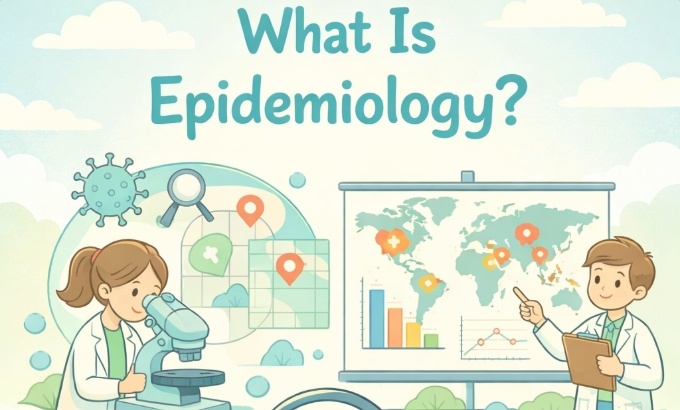
Epidemiology is a foundational discipline in public health. It is commonly defined as the study of the determinants, occurrence, and distribution of health and disease in a defined population, focusing on how diseases spread, who they affect, and why certain populations are at higher risk. This population-based perspective allows researchers and policymakers to identify risk factors, evaluate interventions, and inform evidence-based health decisions.
If you are looking to explore peer-reviewed literature related to epidemiology, PubMed.ai provides an efficient way to search, review, and synthesize evidence from authoritative biomedical sources.
Key elements of epidemiology include:
- Distribution of health events
- Determinants (causes and risk factors)
- Defined populations
- Application to disease prevention and control
What Are the Types of Epidemiology?
According to Columbia Public Health, Epidemiology addresses a broad spectrum of topics, ranging from unintentional injuries to psychosocial stress. Below are several key areas in which Columbia Mailman faculty and students conduct research and practice.
- Infectious diseases
- Chronic Disease (e.g., cancer, heart disease)
- Environmental Epidemiology
- Violence and Injury Epidemiology
What Is the Epidemiology Triangle?
The agent, the host, and the environment.
According to public health education resources from the Texas A&M University School of Public Health, the epidemiological triangle is a conceptual model used to understand how diseases occur and spread by examining the interaction among three essential components: the agent, the host, and the environment.
The U.S. Centers for Disease Control and Prevention (CDC) similarly describes the epidemiological triangle as a model developed to study health problems and better understand how infectious diseases spread within populations, making it a foundational tool in outbreak investigation and public health intervention planning.
| Component | CDC Definition | Key Factors and Examples |
|---|---|---|
| Agent | Originally defined as an infectious microorganism or pathogen, the agent must generally be present for disease to occur, though its presence alone is not always sufficient. Over time, the definition has expanded to include chemical and physical causes of disease or injury. | • Infectious agents: viruses, bacteria, parasites, other microbes • Agent characteristics: pathogenicity, dose • Chemical agents: contaminants (e.g., L-tryptophan contaminant linked to eosinophilia-myalgia syndrome) • Physical agents: mechanical forces (e.g., repetitive motion associated with carpal tunnel syndrome) |
| Host | The human who can acquire the disease. Host-related factors influence exposure, susceptibility, and response to the agent and are often referred to as risk factors. | • Demographic factors: age, sex • Behavioral factors: hygiene, sexual practices, personal behaviors • Biological factors: genetic makeup, nutritional status, immune function • Medical factors: existing diseases, medications • Psychological factors |
| Environment | Extrinsic factors that affect the agent and the opportunity for exposure, shaping whether and how transmission occurs. | • Physical factors: climate, geography, geology • Biological factors: vectors such as insects • Socioeconomic factors: crowding, sanitation, access to health services |
According to the CDC, while the epidemiologic triad is a useful framework for many infectious and injury-related conditions, it is often insufficient for explaining complex diseases such as cardiovascular disease and cancer, which typically involve multiple contributing factors rather than a single necessary cause.
Explore More with PubMed.ai
If you want to quickly search, summarize, and organize biomedical literature, PubMed.ai is a powerful tool. It helps you extract key study insights, generate structured research summaries, and stay organized, so clinicians, researchers, and students can save time while maintaining accuracy. Learn more at PubMed.ai.
Disclaimer:
This AI-assisted content is intended for academic reference and informational purposes only and does not constitute medical advice, diagnosis, or treatment. Always consult qualified healthcare professionals regarding any medical condition or treatment decisions. All risks arising from reliance on this content are borne by the user, and the publisher assumes no responsibility for any decisions or actions taken.

Have a question about biomedical research or published clinical studies? PubMed.ai helps you explore published biomedical literature with AI assistance.
Subscribe to our free Newsletter