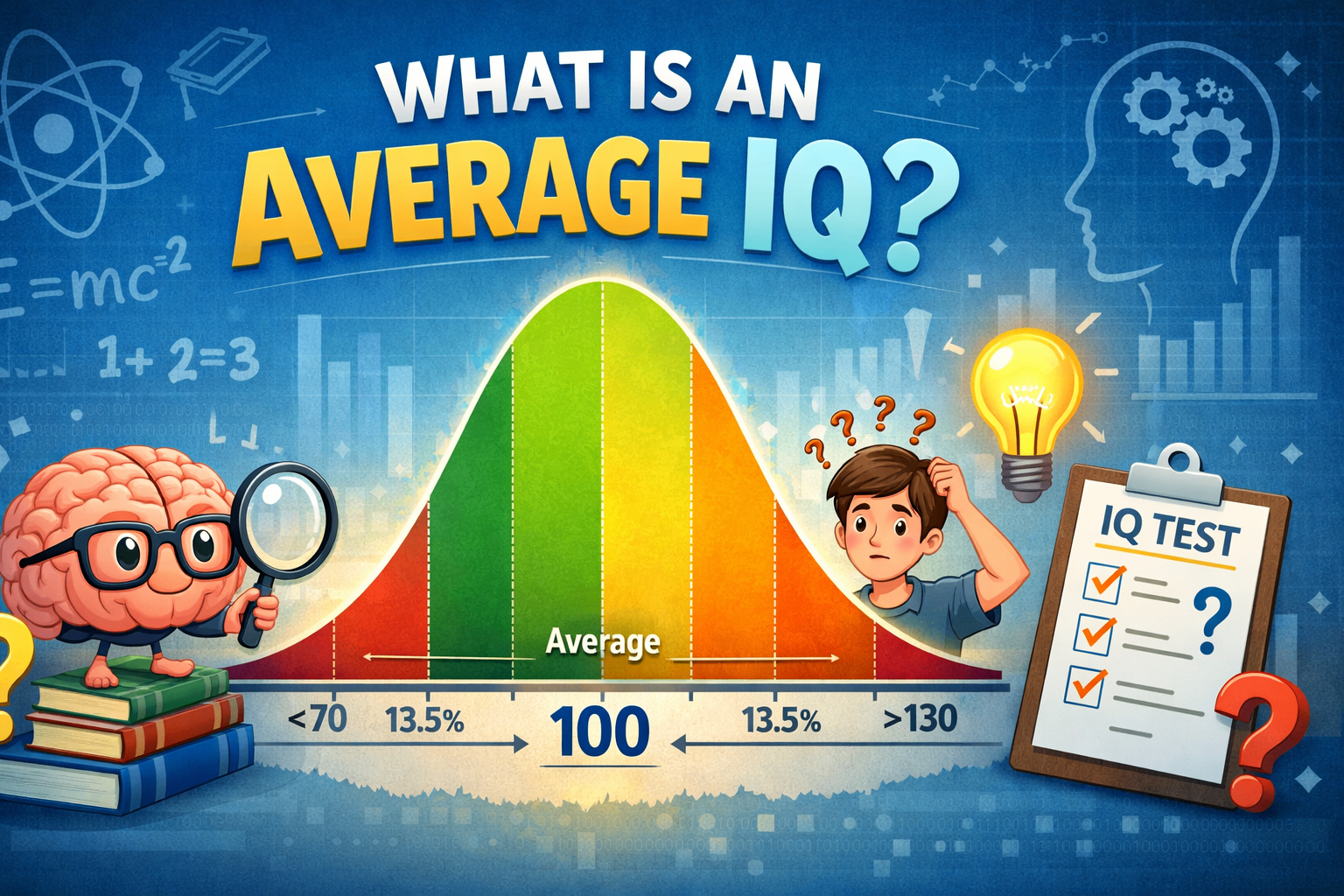
An average IQ is defined as a score of 100 on standardized intelligence tests, representing the statistical midpoint of cognitive performance, and platforms such as PubMed.ai help contextualize this figure by organizing and summarizing publicly available research literature for educational understanding.
In intelligence research, “average” does not imply adequacy, limitation, or expectation. It is a statistical reference point established through large-scale norming procedures. IQ scores are designed to describe relative standing within a population, not fixed intellectual capacity or personal potential.
The average IQ score for the general population typically falls between 90 and 110, with 100 set as the mean by design.
Psychometric standards recognize this range as cognitively typical. When people ask what is an average IQ of a person or what’s the average IQ, they are usually referring to this central band, which includes the majority of adults worldwide. According to the American Psychological Association, these scores reflect normal variation rather than meaningful functional differences.
IQ scores are distributed according to a normal (bell-curve) distribution centered on 100.
Statistically, approximately 68% of individuals score within one standard deviation of the mean (85–115), while about 95% fall between 70 and 130. This distributional model allows researchers to compare cognitive performance across cohorts and time periods, a foundational concept in psychometrics discussed in Encyclopaedia Britannica’s overview of IQ.
The average IQ for adults is 100, the same as for children, because IQ scores are age-normalized.
Standardized tests compare individuals only to others within the same age group. As a result, an adult and a child can both receive an average IQ score despite demonstrating different raw abilities. This age-based normalization process is central to test validity and is outlined in academic testing frameworks published by Cambridge University Press.
The average IQ remains constant across age groups, although the cognitive components contributing to the score may change.
Research distinguishes between fluid intelligence, which involves reasoning and pattern recognition, and crystallized intelligence, which reflects accumulated knowledge. While fluid abilities may decline slightly with age, crystallized abilities often remain stable or increase, balancing overall IQ scores. This phenomenon is well documented in longitudinal cognitive studies summarized by The National Academies Press.
An IQ range chart categorizes scores into statistical bands based on distance from the population mean.
A commonly cited IQ score chart includes:
These categories describe statistical position rather than personal capability. As emphasized in psychometric literature, IQ range charts are analytical tools used in research and educational assessment, not labels of intellectual worth.
A high IQ is generally defined as a score of 120 or above, placing an individual more than one standard deviation above the mean.
From a research perspective, this designation reflects relative performance on standardized cognitive tasks. Scholars consistently caution that high IQ scores do not guarantee academic achievement, creativity, or life outcomes, a distinction reinforced across peer-reviewed psychology research.
An average IQ is measured using standardized, norm-referenced intelligence tests administered to large representative samples.
Well-established instruments such as the Wechsler Adult Intelligence Scale and the Stanford-Binet Intelligence Scales undergo periodic re-standardization to account for demographic and educational changes. Test construction and validation processes follow international guidelines set by organizations such as the International Test Commission.
Reported average IQ scores may vary across countries, but cross-national comparisons are methodologically complex and often contested.
Language, educational access, cultural familiarity with testing formats, and socioeconomic factors all influence results. Contemporary intelligence research increasingly emphasizes environmental context over simplistic ranking, a position supported in comparative education analyses published by the OECD.
The concept of average IQ provides a statistical baseline for understanding cognitive variation within populations.
Researchers use this baseline to evaluate test design, study learning patterns, and interpret population-level trends. Importantly, authoritative psychological research stresses that average IQ should never be interpreted as a measure of personal value, potential, or social contribution.
In addition, IQ reflects only a limited set of cognitive abilities and does not fully capture capacities such as emotional skills, creativity, or social competence, so it should never be treated as the sole indicator of a person’s abilities or worth.
This article is not intended to compare or evaluate the value or abilities of any country, ethnicity, or other social group, and is solely aimed at explaining statistical concepts used in psychological testing.
If you want to quickly search, summarize, and organize biomedical literature for educational and research purposes, PubMed.ai offers a structured way to work with publicly available studies. By highlighting key findings, organizing relevant papers, and supporting the creation of structured research summaries, PubMed.ai helps researchers, educators, and students improve reading efficiency while maintaining academic rigor—without implying clinical authority or institutional affiliation.
By presenting concepts such as average IQ through clearly structured, evidence-based explanations, PubMed.ai supports educational understanding by helping readers explore, organize, and interpret publicly available research literature without implying institutional affiliation or clinical authority.
For more research-based explainers and evidence-informed discussions, explore additional articles in the PubMed.ai blog, including:
An average IQ score for adults is 100, with most adults scoring between 90 and 110.
The average IQ score remains 100 at all ages because scores are normalized within age groups.
A high IQ level is typically defined as 120 or above, based on standard deviations from the mean.
An IQ of 110 is classified as above average, but it remains within the normal population range.
An IQ score chart represents statistical groupings of scores, not fixed limits on intelligence or ability.
Disclaimer:
This AI-assisted content is intended for academic reference and informational purposes only and does not constitute medical advice, diagnosis, or treatment. Always consult qualified healthcare professionals regarding any medical condition or treatment decisions. All risks arising from reliance on this content are borne by the user, and the publisher assumes no responsibility for any decisions or actions taken.

Have a question about biomedical research or published clinical studies? PubMed.ai helps you explore published biomedical literature with AI assistance.
Subscribe to our free Newsletter