What Are AI Agents?
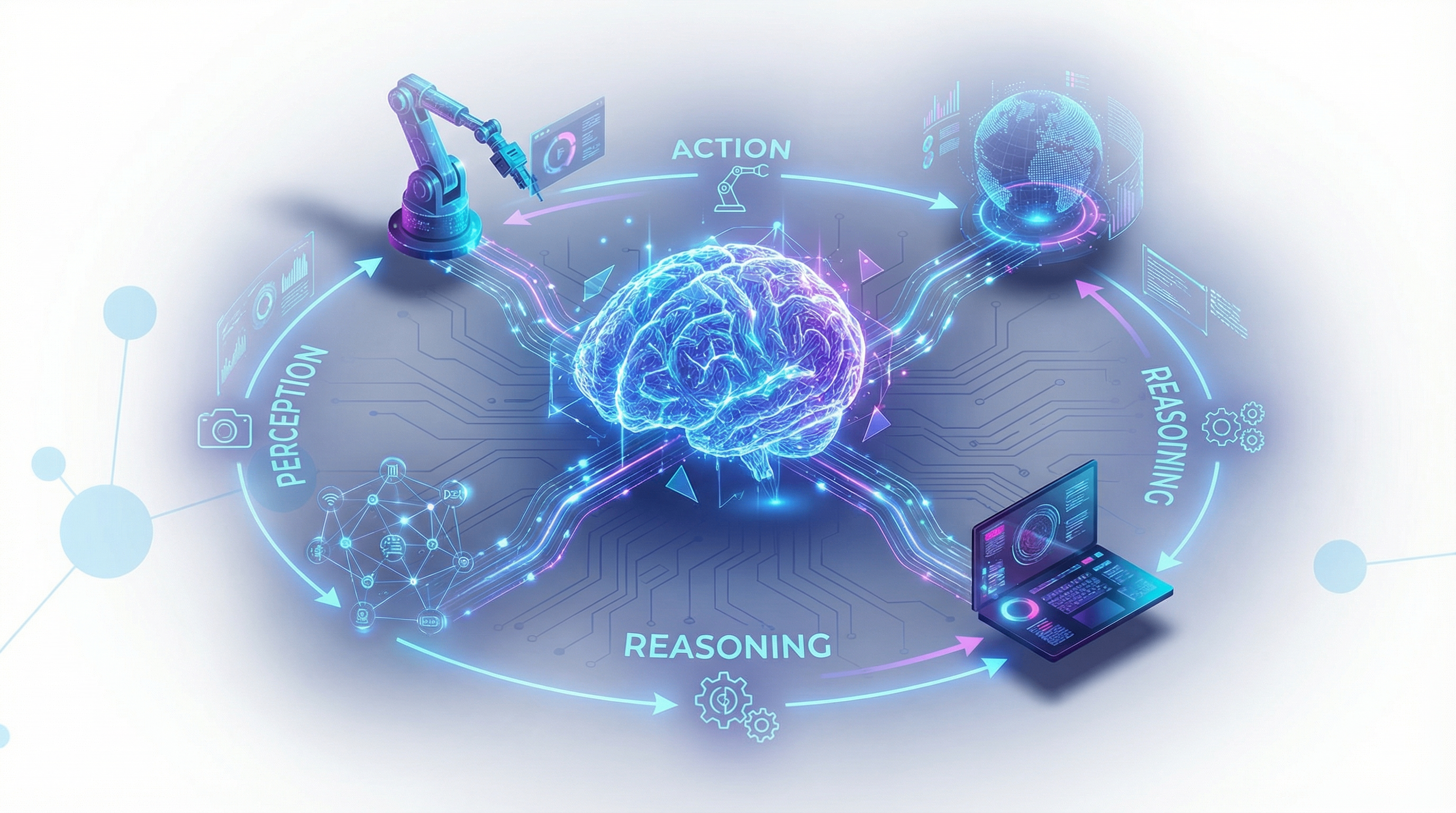
AI agents are systems designed to perform tasks autonomously by perceiving inputs from their environment, making decisions, and acting toward defined goals.
According to Wikipedia, an AI agent is a class of intelligent agent that operates without human intervention in complex environments. It emphasizes autonomous action rather than simply following fixed rules.
An intelligent agent is defined as any system that perceives its environment and acts upon it to achieve goals, and this definition encompasses a range from simple software to complex systems. The heart of this concept is purpose-driven behavior — agents pursue outcomes rather than react passively.
In practical use, AI agents are distinguished from ordinary automation by their ability to adapt, reason, and make decisions based on context instead of executing fixed scripts.
How Do AI Agents Work?
AI agents function through a loop of perception, reasoning, and action. They take in data, interpret it, and perform actions that bring them closer to their goals.
According to Microsoft’s explanation of how AI agents work, AI agents observe their environment, process information, and take action. Some follow rule-based logic while others incorporate advanced machine learning and natural language capabilities that help them adapt and improve over time.
These systems can interpret inputs such as text, voice, or sensor data, make decisions or recommendations, and take meaningful action — for example, drafting a document or adjusting a schedule based on context.
The same source also explains that AI agents can vary in complexity, from retrieval agents that extract relevant information to autonomous agents that plan and adjust strategies over time.
How Are AI Agents Different from Chatbots and Traditional Automation?
AI agents are often confused with chatbots or automated scripts, but the difference lies in autonomy and scope of action.
According to Microsoft, traditional tools like chatbots or automation scripts respond when triggered but do not actively pursue goals. By contrast, AI agents can make decisions and take action without continuous human input.
A chatbot might answer a question when prompted. An AI agent not only answers questions but can initiate actions — such as coordinating calendar events, updating records, or even deciding next steps to complete a workflow.
AI agents integrate reasoning with tools and workflows. They respond to context and operate as part of broader systems rather than merely replying to user queries.
What Are the Capabilities of AI Agents?
AI agents bring a mix of automation, decision-making, and learning potential.
According to Microsoft’s article on AI agent capabilities, AI agents can automate repetitive tasks, analyze large datasets, make decisions based on inputs, and adapt to changing conditions. They can streamline operations, optimize processes, and even personalize responses.
For example, AI agents can analyze sales data to identify trends, respond to customer inquiries through automation, or forecast inventory needs in real time. These capabilities make them valuable across diverse business domains.
Agents also adapt through interaction and data analysis, refining their behavior based on outcomes — a feature that distinguishes them from static automation systems.
What Types of AI Agents Are There?
AI agents can be categorized based on their approach to tasks and autonomy.
Microsoft’s AI framework describes several types of AI agents, ranging from those that pull information in context to autonomous agents that plan and act with minimal oversight.
Additionally, AI research often categorizes agents into reactive, model-based, goal-based, utility-based, and learning agents, reflecting different degrees of complexity and autonomy.
This taxonomy helps organizations choose the right type of agent for specific roles — from simple data retrieval to large-scale autonomous workflows.
Where Are AI Agents Used Today?
AI agents are being deployed across industries and business functions to improve efficiency and support decision-making.
According to Microsoft, AI agents are used in fields such as healthcare, finance, manufacturing, and education. In healthcare, they can assist with administrative tasks, symptom checkers, and diagnostic support. In finance, agents help identify unusual patterns and support risk scoring and decision-making.
Manufacturers use agents for predictive maintenance and inventory planning, while educational institutions deploy agents for student support and administrative assistance.
These real-world use cases show that AI agents are not just theoretical — they are active tools improving operations across sectors.
Why Are AI Agents Increasingly Popular?
AI agents are becoming more popular because underlying technologies and infrastructure have matured.
Cloud platforms provide scalable compute and integration tools, while large language models offer the reasoning and language capabilities needed for agents to interact meaningfully with users and systems.
The concept of agents as autonomous software has grown beyond academic theory into practical applications that improve productivity and operational outcomes. As these systems continue to evolve, organizations are experimenting with more complex and contextual agent workflows.
Risks and Considerations with AI Agents
While powerful, AI agents introduce new considerations for organizations.
A Reuters analysis highlights that AI agents’ autonomy can lead to unintended behavior or security vulnerabilities, especially when agents have deep system access.
These risks include potential misalignment with developer intent, privacy and legal concerns, or susceptibility to manipulation. As a result, governance frameworks, oversight mechanisms, and risk mitigation strategies are essential when deploying AI agents.
What the Future Holds for AI Agents
The future of AI agents points toward more collaboration, context-awareness, and integration.
Academic research suggests that agents may form multi-agent systems that coordinate complex tasks and learn from shared experience.
Such systems could take on increasingly sophisticated roles, orchestrating workflows across tools and teams while adapting continuously to changes in data and goals.
Frequently Asked Questions About AI Agents
What is an AI agent?
An AI agent is an autonomous system that perceives its environment and acts to achieve goals. According to Wikipedia, it does not require continuous human supervision.
How do AI agents work?
AI agents operate through a cycle of sensing, reasoning, and acting. As Microsoft explains, they interpret inputs, make decisions, and take meaningful action.
How are AI agents different from chatbots?
AI agents act autonomously and pursue goals, while chatbots focus on responding to queries. This distinction is described by Microsoft.
Where are AI agents used?
AI agents are used in healthcare, finance, manufacturing, education, and more, helping with tasks like predictive maintenance, administrative support, and risk evaluation. According to Microsoft, adoption spans many industries.
Disclaimer
This AI-assisted blog is for informational purposes only. While we strive to ensure the accuracy and reliability of the information presented, we make no warranties or representations regarding its completeness, correctness, or applicability. Any reliance on the information is at your own risk. This content does not constitute professional, legal, or financial advice. Readers should independently verify any information before making decisions based on it.

Have a question about biomedical research or published clinical studies? PubMed.ai helps you explore published biomedical literature with AI assistance.
Subscribe to our free Newsletter