logo
Clinical Practitioners
Biomedical Researchers & Scientists
Medical Students & Academic Educators
Professionals in Pharmaceutical Companies
How to Search
How it Works
Search Now
Home>Biomedical Insights>
NPO Medical Abbreviation: Understanding Its Meaning and Academic Use

NPO Medical Abbreviation: Understanding Its Meaning and Academic Use

Written by Connor Wood
January 9, 20264 min read

NPO Medical Abbreviation: Understanding Its Meaning and Academic Use

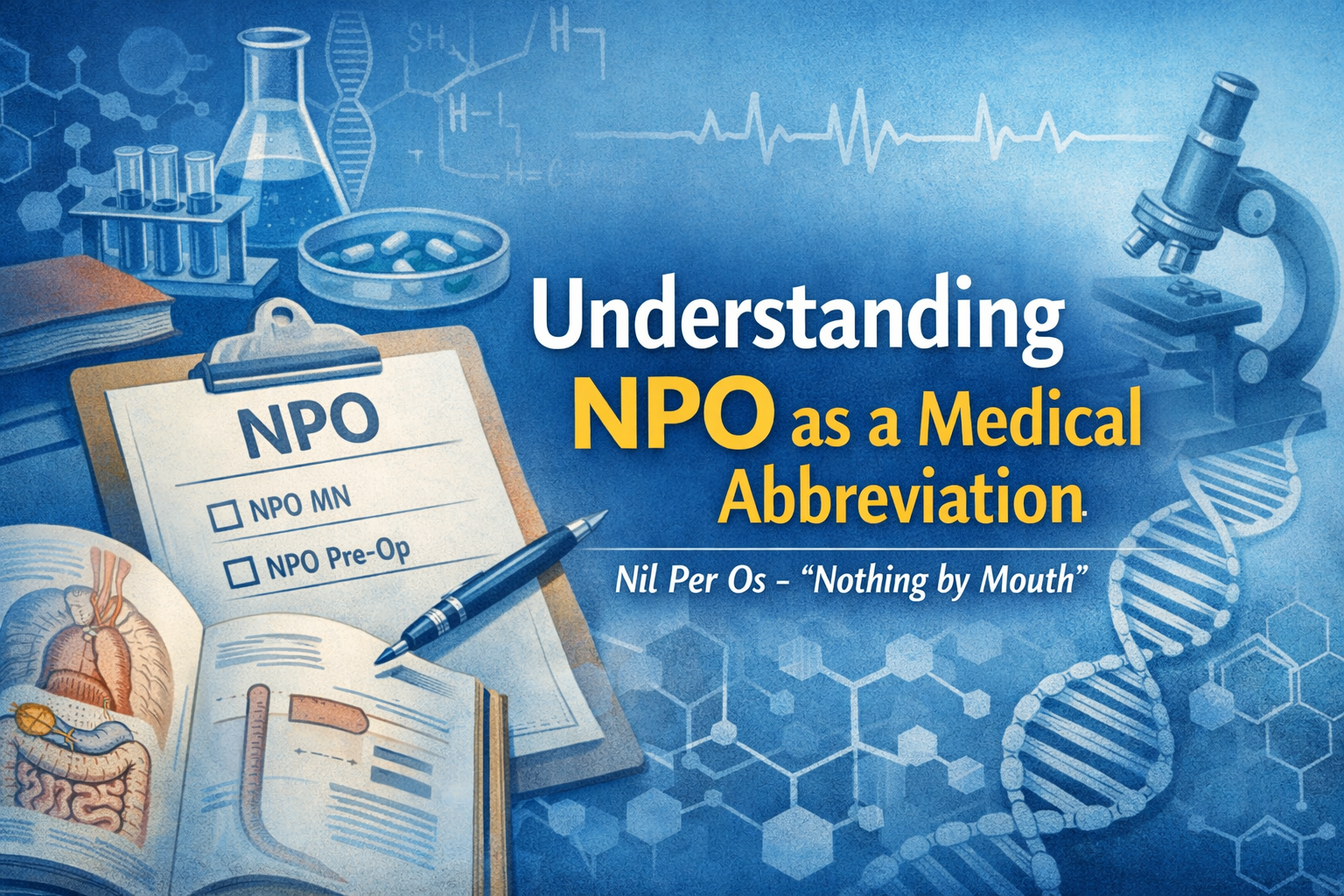
NPO stands for “nil per os,” a Latin phrase meaning “nothing by mouth.” In research and academic contexts, it is used to indicate a period during which oral intake is restricted, commonly documented in case reports, observational studies, and procedural research.
 NPO Medical Abbreviation

If you need to efficiently search, interpret, and summarize medical terminology in peer-reviewed literature, PubMed.ai provides a streamlined, evidence-driven workflow.

NPO Medical Abbreviation

What Does NPO Mean in Academic and Research Contexts?

NPO literally translates from Latin as “nil per os,” denoting periods when oral intake is restricted. Its significance lies in its frequent appearance in case reports, research studies, and clinical documentation used for analysis.

Latin abbreviations like NPO, PRN (pro re nata), and QD (quaque die) remain in use because they provide a concise, internationally recognized shorthand. According to the NCI Dictionary of Cancer Terms, NPO is often referenced in oncology and surgical literature, illustrating its utility as a descriptive variable in research.

Pronunciation varies slightly: some sources use each letter separately (“N-P-O”), while others pronounce it more fluidly (“en-po”). Misinterpretation in research datasets can affect data categorization, highlighting the importance of consistent usage in academic contexts.


When and Why Is NPO Documented in Research?

In research, NPO is recorded to describe fasting periods relevant to procedural observation, pharmacokinetic studies, or retrospective analysis. It is not intended as a clinical instruction but as a descriptive variable for study design and reporting.

Observational literature, such as guidance summarized by St. Jude Medical Care, reports fasting windows used in studies for descriptive purposes. These include clear liquids, breast milk, infant formula, light meals, and heavier meals. Such data serve as references for research comparisons, study design, and variable standardization rather than as directives for patient care.


How Does NPO Vary Across Study Populations?

NPO documentation varies across age groups, study populations, and research contexts. Pediatric studies often record shorter oral restriction periods, while adult procedural studies may note longer fasting intervals. Obstetrics-related studies, such as those involving IVF or cesarean procedures, document NPO windows to describe subject status in observational datasets.

These distinctions are essential in academic research for standardizing variables, comparing cohorts, and ensuring reproducibility in data analysis.


What Are the Common Variations of NPO in Research Documentation?

NPO is frequently documented with variations that provide specific descriptive information:

  • NPO MN​: nil per os after midnight (descriptive in datasets)
  • NPO pre-op​: fasting prior to a procedure (observational variable)
  • NG TPN NPO​: nil per os with nasogastric tube and total parenteral nutrition
  • NPO p MN​: alternative notation for fasting after midnight

Understanding these distinctions ensures accurate data categorization and analysis in research studies, especially in retrospective reviews or systematic literature syntheses.


What Are the Documented Fasting Times in Literature?

Academic sources document fasting durations to describe subject states in research. For example, summaries based on observational literature report:

  • Clear liquids: up to 2 hours
  • Breast milk: up to 4 hours
  • Infant formula: up to 6 hours
  • Light meals: up to 6 hours
  • Fatty or heavy meals: up to 8 hours

These timeframes are cited to standardize research variables and facilitate cross-study comparisons, rather than for clinical decision-making.

How Does NPO Appear in Research Data?

Answer: NPO is commonly recorded in electronic medical records and study datasets to describe subject status during procedural observation, pharmacokinetic evaluation, or retrospective analysis. Variations such as NPO MN, NPO pre-op, and NG TPN NPO help standardize datasets and reduce ambiguity when comparing studies or extracting data.

Researchers should interpret these notations as descriptive variables in academic work. Precise understanding is critical for data accuracy, reproducibility, and reliability of research conclusions.


Why Is Latin Still Used in Abbreviations Like NPO?

Answer: Latin abbreviations provide standardized shorthand that facilitates consistency across studies, historical records, and international literature. Using NPO, PRN, or QD reduces ambiguity, especially when reviewing multi-decade datasets or integrating older studies into systematic reviews.

From a research perspective, Latin abbreviations help maintain clarity in data extraction, coding, and meta-analysis. Historical continuity ensures longitudinal validity when analyzing trends or outcomes documented over extended periods.


How Should Students and Early-Career Researchers Approach NPO?

Answer: Students and early-career researchers should focus on understanding NPO definitions, variations, and context in literature. Awareness of how NPO is recorded in research datasets helps maintain consistency in data extraction, citation, and analysis.

Tools such as PubMed.ai allow researchers to verify terminology, explore study-specific applications, and synthesize structured summaries for literature reviews. Using these tools ensures accurate academic interpretation without implying clinical application.

Practical tips include maintaining a reference glossary of abbreviations, reviewing documented NPO windows in literature, and cross-checking notations when analyzing datasets.

Explore More with PubMed.ai

For medical researchers and students seeking to efficiently search, summarize, and organize biomedical literature, PubMed.ai offers an evidence-driven solution. From confirming medical abbreviations like NPO to generating structured reports, PubMed.ai saves time while maintaining the highest standards of accuracy and reproducibility, allowing you to focus on insights and outcomes.​

FAQs

What does NPO mean in academic contexts?

NPO stands for “nil per os,” indicating periods during which oral intake is restricted. It is used as a descriptive variable in research and literature.

What are typical NPO time ranges reported in literature?

Reported durations include 2 hours for clear liquids, 4 hours for breast milk, 6 hours for light meals or infant formula, and 8 hours for heavy meals, based on observational studies.

Do NPO variations exist across study types or populations?

Yes. Pediatric, obstetric, and adult procedural studies often record NPO differently, reflecting study-specific design and subject characteristics.

What do NPO MN or NPO pre-op indicate in research data?

These denote descriptive fasting periods: NPO MN specifies fasting after midnight, and NPO pre-op indicates fasting prior to a procedure, as documented in research datasets.

Why is Latin still used in abbreviations like NPO?

Latin provides standardized, internationally recognized shorthand that ensures clarity and consistency in research documentation and literature analysis.

Disclaimer:
This AI-assisted content is intended for academic reference and informational purposes only and does not constitute medical advice, diagnosis, or treatment. Always consult qualified healthcare professionals regarding any medical condition or treatment decisions. All risks arising from reliance on this content are borne by the user, and the publisher assumes no responsibility for any decisions or actions taken.