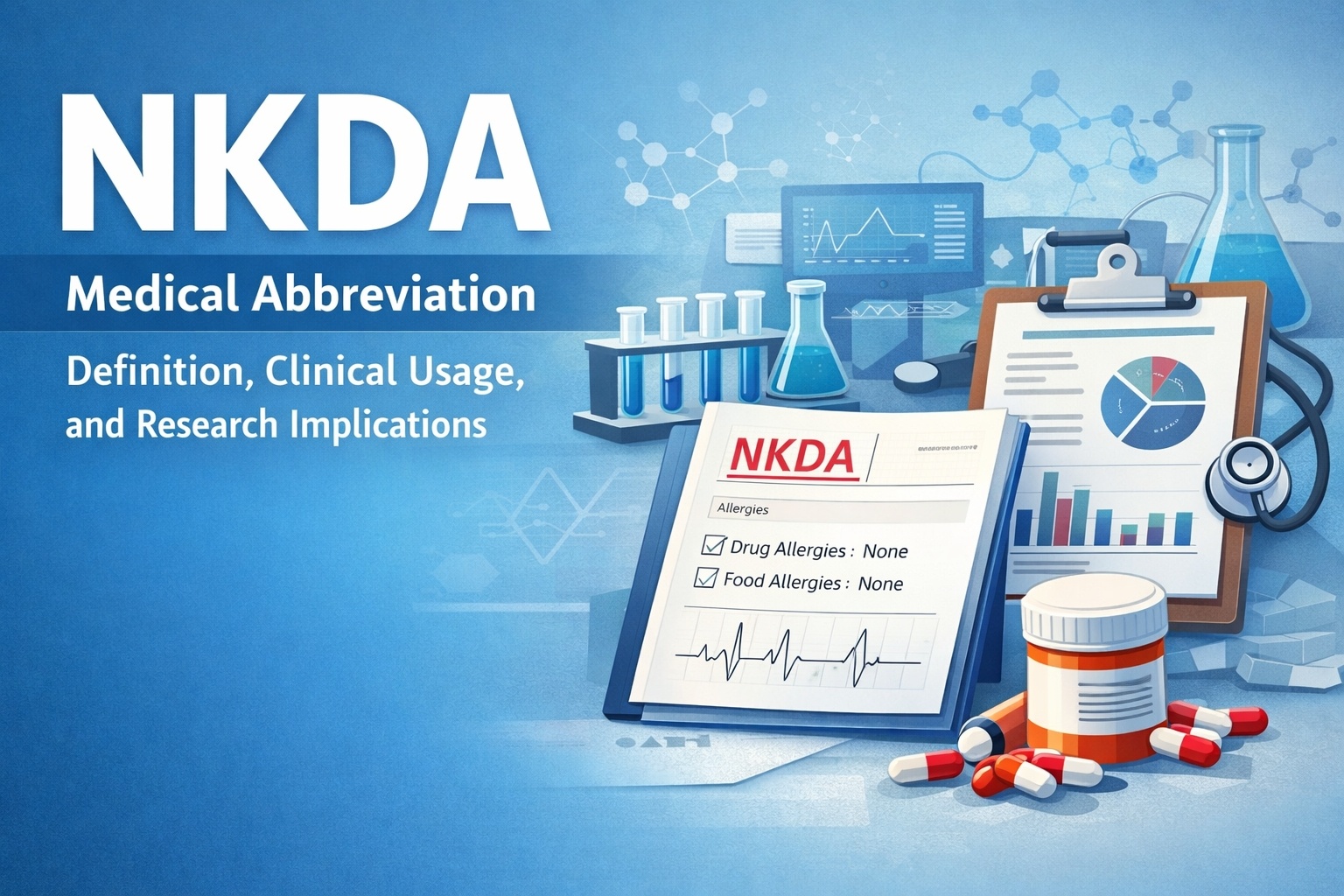
NKDA stands for No Known Drug Allergies, a clinical designation used to indicate that a patient has no documented or reported allergic reactions to medications at the time of assessment. If you need to efficiently verify medical abbreviations, trace their usage across peer-reviewed studies, and understand how terminology is operationalized in research contexts, PubMed.ai offers an evidence-driven workflow that combines semantic search with citation-linked summaries. Learn more at pubmed.ai.
NKDA means that no drug allergies are currently known or recorded for a patient.
The phrase is intentionally cautious. “No known” reflects the limits of available information rather than a definitive biological state. In clinical documentation, NKDA signals that the patient has either denied prior drug allergies or that none have been identified through history taking and record review.
Authoritative clinical glossaries, such as those maintained by the U.S. National Library of Medicine, emphasize this distinction between absence of evidence and evidence of absence . For researchers, this nuance matters because NKDA is frequently treated as a binary variable in datasets, even though it represents conditional knowledge.
NKA means No Known Allergies and refers to a broader category than NKDA.
While NKDA is limited to medications, NKA encompasses all allergy types, including food, environmental, and material allergies (such as latex). In structured medical records, these two abbreviations ideally occupy separate fields, reflecting different clinical implications.
However, studies of electronic health record (EHR) usage have shown inconsistent application of these terms, with NKDA sometimes used as a proxy for NKA. This inconsistency has been discussed in clinical informatics literature, including analyses published in journals indexed by PubMed.
Because “no known” indicates incomplete certainty rather than confirmed absence.
A patient labeled NKDA may later experience an allergic reaction to a medication they have never previously encountered. Additionally, prior reactions may have been undocumented, misclassified, or forgotten. Clinical pharmacology references, such as those from the FDA’s drug safety communications, consistently stress that allergy histories are provisional and should be reassessed over time.
From a research perspective, treating NKDA as a definitive negative can introduce misclassification bias, particularly in pharmacovigilance and adverse event studies.
They appear throughout routine medical records as standardized shorthand for allergy status.
Common locations include admission notes, medication reconciliation forms, anesthesia records, and discharge summaries. In EHR systems, NKDA is often a selectable default value, which can inadvertently propagate incomplete data if allergy histories are not actively reviewed.
Clinical documentation standards discussed by organizations such as Health Level Seven International (HL7) highlight the importance of structured, regularly updated allergy fields to reduce ambiguity.
They are frequently used as data points in observational studies and clinical trials.
Allergy status can influence eligibility criteria, safety monitoring, and subgroup analyses. For example, a trial evaluating antibiotic efficacy may exclude participants with documented drug allergies, relying on NKDA status to define eligibility.
Methodological reviews have noted that variability in allergy documentation can affect reproducibility and external validity. Researchers are therefore encouraged to cross-reference NKDA with adverse drug reaction reports and medication discontinuation data, as recommended in pharmacoepidemiology literature indexed by PubMed.
The most common errors involve overgeneralization and outdated information.
Side effects such as gastrointestinal discomfort are sometimes incorrectly recorded as allergies, while true immunologic reactions may be underreported. Another frequent issue is the failure to update allergy status over time, resulting in persistent NKDA labels that no longer reflect the patient’s experience.
Guidance from the World Allergy Organization underscores the importance of distinguishing adverse drug reactions from true allergies to improve patient safety and data quality.
NKDA and NKA are part of a broader ecosystem of allergy-related shorthand.
They often appear alongside abbreviations such as PCN (penicillin), ADR (adverse drug reaction), or DA (drug allergy). Occasionally, nonstandard variants like “NKDK” appear in informal contexts, though these lack formal recognition and should be interpreted cautiously.
Comprehensive lists of standardized abbreviations, such as those provided by academic medical centers and safety organizations, help reduce ambiguity in both education and practice.
Because early familiarity with precise terminology supports safer clinical reasoning and stronger research skills.
Understanding how NKDA is defined, limited, and sometimes misused prepares students to critically evaluate patient records and published studies. It also reinforces a broader principle of medicine: documentation reflects human processes and is always subject to revision.
Educational research has shown that students who engage critically with clinical language early are better equipped to identify data limitations later in their careers, particularly in research and evidence synthesis.
Because subtle documentation choices can influence aggregated outcomes.
In systematic reviews or database studies, allergy status may appear as a minor variable, yet it can shape treatment pathways and reported adverse events. Misinterpreting NKDA as a definitive negative can therefore distort findings, especially in large-scale analyses.
Modern literature analysis platforms increasingly emphasize context-aware interpretation of clinical terminology. Tools that allow researchers to trace how abbreviations are defined and used across studies help mitigate these risks.
By approaching it with precision rather than assumption, medical students and researchers strengthen both practice and scholarship. If you need to search, interpret, and validate medical terminology across peer-reviewed literature—with structured summaries and citation-linked insights—PubMed.ai provides a streamlined, research-focused solution. Explore its capabilities at pubmed.ai.
NKDA stands for No Known Drug Allergies, indicating that a patient has no documented or reported allergies to medications at the time of assessment.
NKDA refers specifically to drug allergies, while NKA (No Known Allergies) covers all types of allergies, including food, environmental, and material allergies.
No. “No known” reflects the limits of available information rather than a definitive absence. Patients may still develop allergic reactions to previously unencountered medications.
NKDA is commonly recorded in admission notes, medication reconciliation forms, anesthesia records, discharge summaries, and EHR systems as a selectable default for allergy status.
NKDA is used as a data point for eligibility, safety monitoring, and subgroup analyses in clinical trials and observational studies. Misinterpretation can introduce bias in pharmacovigilance and adverse event research.
Errors include overgeneralization, outdated information, misclassification of side effects as allergies, and failure to update allergy status over time.
Early familiarity with NKDA and NKA improves clinical reasoning, record evaluation, and evidence synthesis skills, reducing risk in both practice and research.
Disclaimer:
This AI-assisted content is intended for academic reference and informational purposes only and does not constitute medical advice, diagnosis, or treatment. Always consult qualified healthcare professionals regarding any medical condition or treatment decisions. All risks arising from reliance on this content are borne by the user, and the publisher assumes no responsibility for any decisions or actions taken.

Have a question about medical research, clinical practice, or evidence-based treatment? Access authoritative, real-time insights: PubMed.ai is an AI-Powered Medical Research Assistant.
Subscribe to our free Newsletter