
logo
Clinical Practitioners
Biomedical Researchers & Scientists
Medical Students & Academic Educators
Professionals in Pharmaceutical Companies
How to Search
How it Works
Search Now
Home>Biomedical Insights>
Discuss the Interdependence of the Components of Wellness

Discuss the Interdependence of the Components of Wellness

Written by Connor Wood
January 14, 20264 min read

The interdependence of the components of wellness means that physical, mental, emotional, social, environmental, and related dimensions of health operate as an integrated system—changes in one component directly and indirectly influence the others.
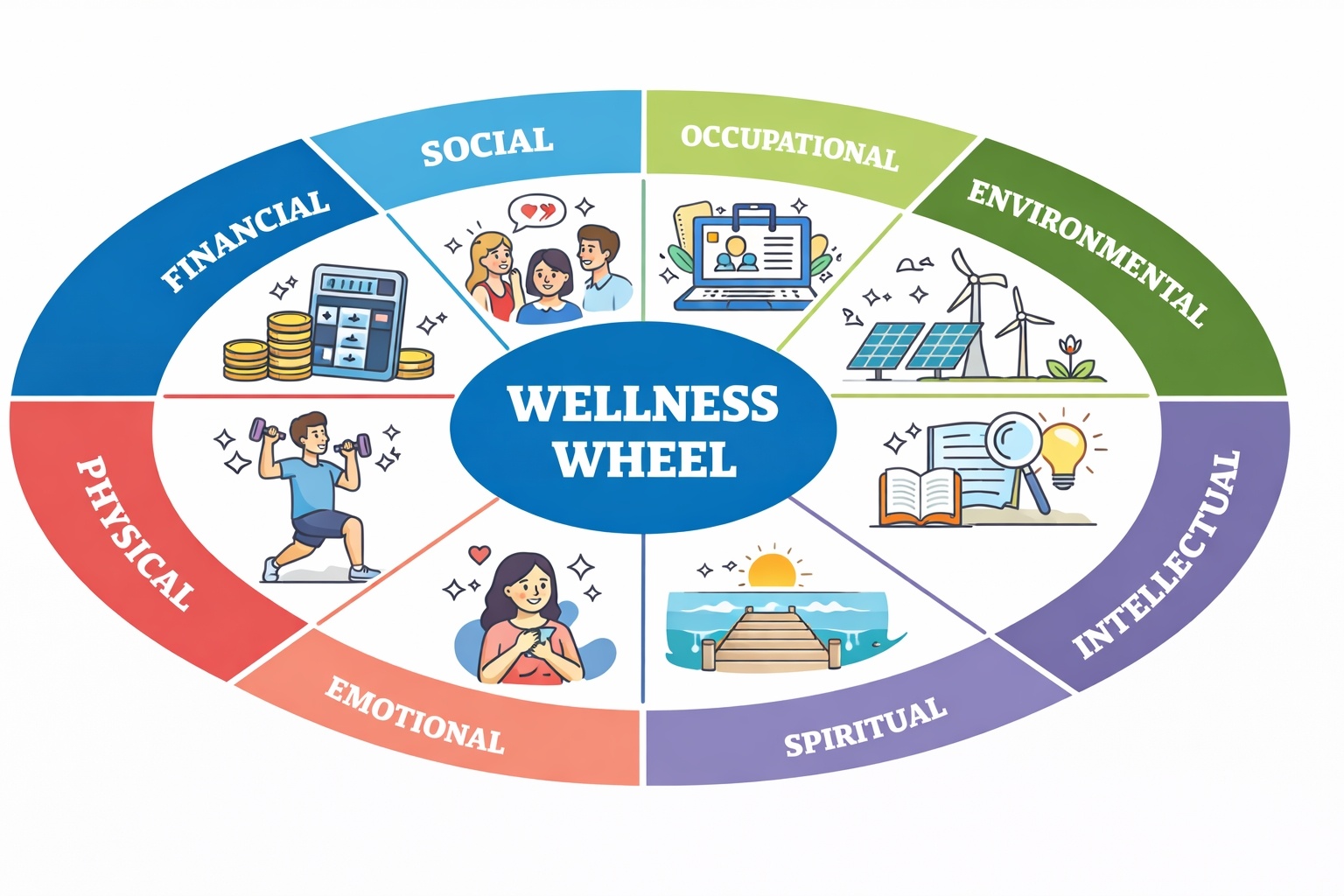
discuss the interdependence of the components of wellness

This definition reflects how wellness is described in health education, public health, and biomedical research. For readers who want to verify terminology, compare academic phrasing, or review how this concept appears in peer-reviewed literature, PubMed.ai enables structured searching and evidence-linked synthesis across biomedical sources.

Check the answer from PubMed.ai

What are the components of wellness?

The components of wellness are distinct health domains that collectively describe overall well-being.
Most academic frameworks include the following components:

  • Physical wellness – exercise, sleep, nutrition, disease status
  • Mental / emotional wellness – stress regulation, mood, psychological resilience
  • Social wellness – relationships, social support, community engagement
  • Intellectual wellness – learning, cognitive engagement, curiosity
  • Environmental wellness – living conditions, safety, environmental exposures
  • Occupational wellness – work demands, role satisfaction, job stability
  • Spiritual wellness (in some models) – meaning, values, sense of purpose

Authoritative definitions, such as the ​World Health Organization’s concept of health​, explicitly frame health as physical, mental, and social well-being, establishing interdependence as a foundational principle.

What does “interdependence” mean in a wellness context?

Interdependence means no wellness component functions independently; each influences and is influenced by the others.
This relationship is best understood as a feedback system rather than a linear cause-and-effect chain.

Key characteristics of wellness interdependence:

  • Bidirectional influence between components
  • Reinforcing effects (positive or negative)
  • Simultaneous biological, psychological, and social pathways

This framing explains why exam questions asking students to discuss the interdependence of the components of wellness require explanation rather than listing.

How does physical wellness influence other components?

Physical wellness affects nearly all other wellness domains through physiological and behavioral mechanisms.

Examples of downstream effects:

  • Regular physical activity improves:
    • Mood and emotional regulation
    • Cognitive performance
    • Sleep quality
  • Poor physical health contributes to:
    • Psychological stress
    • Reduced social participation
    • Lower occupational functioning

Evidence summarized by the Centers for Disease Control and Prevention on physical activity supports the commonly stated principle that regular exercise is positively related to wellness across multiple dimensions.

How does mental and emotional wellness affect physical health?

Mental and emotional wellness shape physical health through stress, behavior, and neuroendocrine pathways.

Key mechanisms include:

  • Chronic stress → hormonal dysregulation
  • Emotional distress → poor sleep and nutrition patterns
  • Psychological fatigue → reduced physical activity

The National Institute of Mental Health documents how mental health conditions are associated with increased risk for chronic physical illness, demonstrating that mental wellness is a determinant, not merely a consequence, of physical health.

Why is social wellness considered a core component?

Social wellness influences health outcomes by affecting stress buffering, behavior adherence, and emotional stability.

Research consistently shows that:

  • Strong social support improves:
    • Stress resilience
    • Health behavior compliance
  • Social isolation is associated with:
    • Increased morbidity
    • Higher all-cause mortality

Findings summarized by the Harvard T.H. Chan School of Public Health position social connection as a health factor comparable to traditional biomedical risks.

How does environmental wellness interact with other components?

Environmental wellness shapes health by determining exposure, access, and daily behavior.

Environmental factors influence:

  • Physical wellness through air, water, and housing quality
  • Mental wellness through noise, crowding, and safety
  • Social wellness through community design and accessibility

According to the ​U.S. Environmental Protection Agency’s environmental health overview​, environmental conditions modify both disease risk and health-related behavior, reinforcing interdependence across wellness domains.

What role does occupational wellness play in overall wellness?

Occupational wellness affects mental, physical, and social health through workload, control, and role stability.

Documented effects include:

  • High job strain → emotional exhaustion
  • Prolonged stress → physical symptoms
  • Occupational imbalance → reduced social engagement

The World Health Organization’s workplace health resources identify occupational stress as a major contributor to systemic health decline.

How do intellectual and spiritual wellness contribute to interdependence?

Intellectual and spiritual wellness support motivation, resilience, and long-term health behavior.

Their contributions include:

  • Intellectual engagement → cognitive flexibility and learning capacity
  • Sense of meaning → stress tolerance and persistence

Although less emphasized in short-answer formats, these components influence adherence to healthy behaviors and support emotional stability, indirectly affecting physical and social wellness.

Why is this concept emphasized in physical fitness education?

Physical fitness education highlights interdependence to discourage reductionist views of health.

From a teaching perspective:

  • Exercise behavior depends on:
    • Mental motivation
    • Social support
    • Environmental access
  • Fitness outcomes cannot be sustained without:
    • Emotional regulation
    • Occupational balance

This explains why platforms like Quizlet or Brainly frequently connect physical fitness basics to broader wellness discussions.

How should students structure a strong academic answer?

A strong answer defines interdependence, identifies components, and explains reciprocal influence using examples.

Recommended structure:

  1. Define interdependence
  2. Identify core wellness components
  3. Explain how change in one affects others
  4. Use clear, concrete examples

This approach aligns with how wellness is framed in public health and biomedical literature.

Why does wellness interdependence matter beyond exams?

Interdependence underpins preventive medicine, health promotion, and research design.

In biomedical contexts, it explains:

  • Why single-factor interventions often underperform
  • Why multi-domain approaches yield stronger outcomes
  • How behavioral and biological variables interact

Understanding this concept improves interpretation of population data and intervention studies.

What is the key takeaway for biomedical learners?

Wellness is a systems-level construct: physical, mental, social, and environmental components continuously interact to shape health outcomes.
Recognizing this interdependence supports clearer academic reasoning and more accurate interpretation of health research. To explore how this concept is discussed across peer-reviewed studies, or to confirm definitions used in academic writing, PubMed.ai offers a reliable, evidence-driven research workflow.

Recommended Reading

For readers who want to further explore how mental, emotional, and cognitive dimensions interact within broader wellness frameworks, the following articles from PubMed.ai provide research-driven context:

  • Is Major Depressive Disorder a Disability? — Examines major depressive disorder through clinical, functional, and legal lenses, illustrating how mental health conditions influence occupational, social, and overall wellness.
  • OCD vs OCPD — Provides a clear, evidence-based comparison of obsessive-compulsive disorder and obsessive-compulsive personality disorder, highlighting diagnostic distinctions and their implications for emotional and behavioral wellness.
  • Current Limitations of Neuropsychological Testing — Discusses methodological and interpretive constraints in neuropsychological assessment, offering insight into how intellectual and mental wellness are evaluated in research and clinical practice.

FAQs

What is the interdependence of the components of wellness?

It is the principle that wellness dimensions influence one another rather than functioning independently.

Why is exercise frequently used as an example in wellness discussions?

Because physical activity affects mental, emotional, and social health simultaneously, illustrating interdependence clearly.

Is wellness interdependence supported by research evidence?

Yes. Epidemiological, psychological, and public health studies consistently support this systems-based view.

How does this concept appear in homework or exam questions?

It is commonly presented as a short-answer or essay prompt asking for explanation of relationships, not simple listing.

Disclaimer:
This AI-assisted content is intended for academic reference and informational purposes only and does not constitute medical advice, diagnosis, or treatment. Always consult qualified healthcare professionals regarding any medical condition or treatment decisions. All risks arising from reliance on this content are borne by the user, and the publisher assumes no responsibility for any decisions or actions taken.