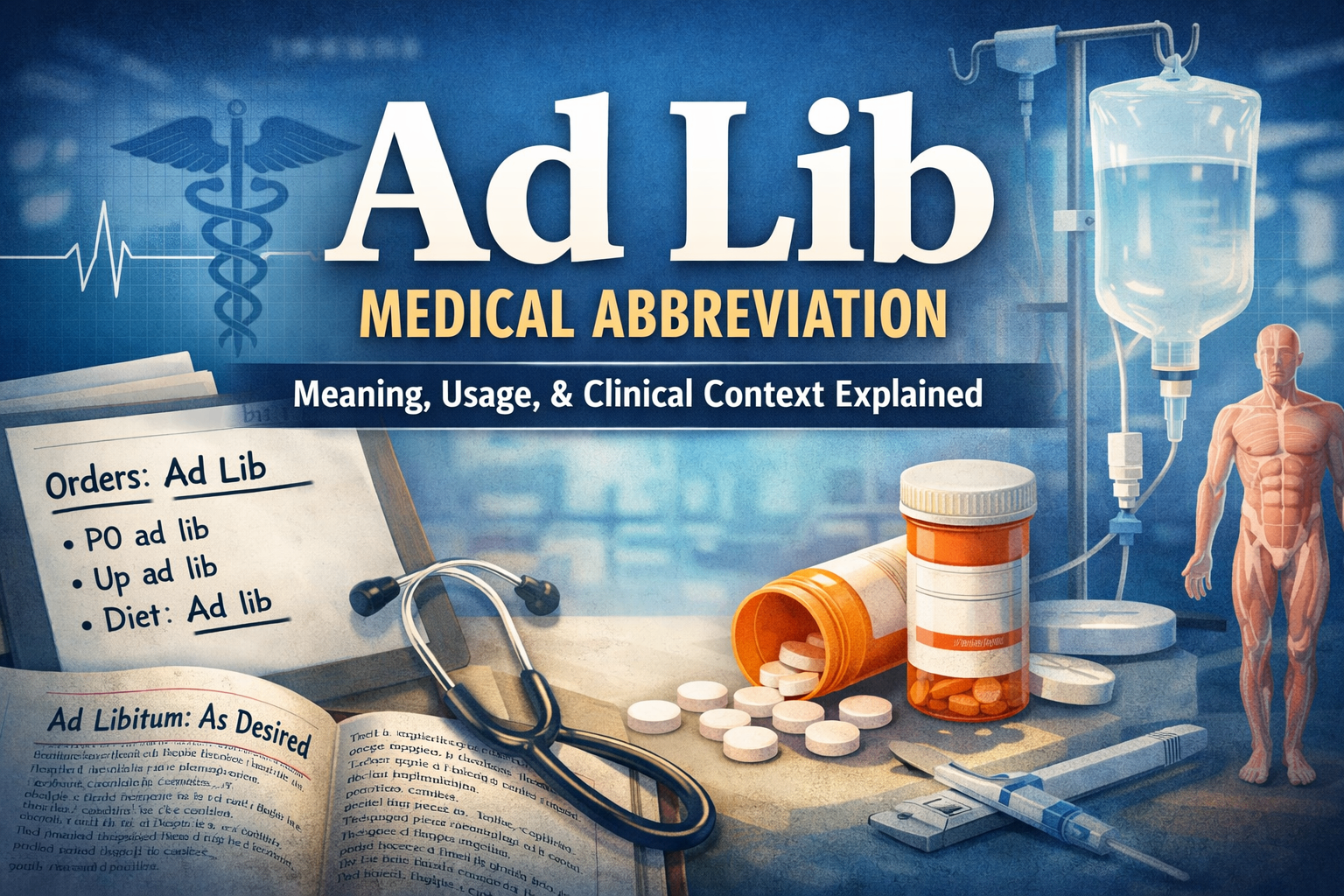
The medical abbreviation ad lib means “as desired” or “without restriction,” derived from the Latin ad libitum, and is used in healthcare documentation to indicate that a patient may perform an activity or consume food, fluids, or medications freely within clinically acceptable limits.
If you need to verify how abbreviations like ad lib are defined, operationalized, and cited across peer-reviewed medical literature, PubMed.ai provides a structured, evidence-driven workflow that connects terminology to real clinical and research contexts through semantic search and citation-linked summaries.
In medical terminology, ad lib signifies permission rather than prescription, allowing an action to occur according to patient tolerance rather than a fixed schedule.
The phrase originates from ad libitum, a Latin expression historically used to denote freedom of choice. In healthcare documentation, this freedom is constrained by clinical judgment, institutional policy, and patient safety considerations.
Unlike time-bound or dose-bound instructions, ad lib does not specify quantity, frequency, or duration. Instead, it assumes that the clinician has determined no explicit restriction is necessary at the time of documentation.
Authoritative definitions consistently emphasize this conditional flexibility. For example, RxList’s medical definition of ad lib describes it as permitting action “to the full extent of one’s wishes,” while implicitly operating within medical oversight.
“Ad lib” is used when clinical risk is low enough that rigid control is unnecessary and patient autonomy can be safely preserved.
Healthcare systems rely on structured orders to reduce ambiguity, but over-specification can create inefficiencies or unnecessary interventions. Ad lib functions as a deliberate simplification.
In inpatient settings, this often applies to:
Rather than signaling neglect, ad lib signals clinical confidence. It reflects an assessment that the patient’s condition does not require continuous regulation for that specific activity.
The ad lib medical abbreviation is applied as a modifier within orders, notes, and care plans to relax otherwise common constraints.
It rarely appears in isolation. Instead, it modifies another instruction.
Common chart examples include:
These constructions demonstrate that ad lib removes scheduling rigidity but not professional responsibility. Monitoring remains implicit.
Clinical documentation standards discussed in sources such as MedlinePlus Medical Encyclopedia reinforce that abbreviations must be interpreted contextually rather than literally.
“Up ad lib” means a patient may ambulate or change position freely without requiring scheduled assistance or restriction.
This phrase is most common in inpatient and post-operative environments once mobility restrictions are lifted.
The order assumes:
Importantly, up ad lib does not negate nursing supervision. It shifts responsibility from protocol-driven mobilization to patient-initiated movement under observation.
From a research perspective, mobility orders such as up ad lib can influence outcomes related to length of stay, deconditioning, and post-discharge recovery, making accurate interpretation essential when reviewing clinical records.
“PO ad lib” indicates that oral intake is permitted freely, subject to safety considerations such as swallowing function and metabolic limits.
“PO” (per os) specifies the route of administration, while ad lib removes timing and quantity constraints.
This order is common in:
Pharmacological implications remain significant. As noted in pharmacy documentation standards published by StatPearls, ad lib intake does not override maximum dosage thresholds or contraindications.
Although the definition of ad lib is stable, its operational meaning varies by professional role.
For nursing staff, ad lib influences monitoring intensity and workload distribution.
For pharmacists, it requires reconciliation with dose ceilings and interaction profiles.
For CNAs, it modifies assistance routines without eliminating oversight.
In veterinary medicine, where ad lib medical abbreviation veterinary usage often applies to feeding or hydration, interpretation is more conservative due to the patient’s inability to self-report tolerance.
This variability underscores why abbreviation literacy is essential for interdisciplinary teams.
“Ad lib” is frequently misinterpreted because its linguistic simplicity masks its clinical conditionality.
Students may incorrectly equate ad lib with “unlimited” or “unmonitored,” leading to documentation or interpretation errors.
Educational materials from institutions such as Cleveland Clinic stress that medical abbreviations must be read within the broader care plan, not as standalone directives.
For researchers analyzing chart data, misreading ad lib can introduce bias, particularly in studies involving nutrition, mobility, or medication adherence.
In research contexts, ad lib denotes protocol-permitted variability that may affect reproducibility and outcome interpretation.
Ad libitum feeding, activity, or dosing can introduce heterogeneity into study populations.
When reviewing literature, researchers should:
Tools like PubMed.ai enable researchers to trace how ad libitum conditions are described across studies, compare methodological language, and validate interpretation through linked citations rather than assumption.
Ad lib occupies a distinct category among medical abbreviations because it relaxes control rather than imposing it.
Unlike PRN, BID, or NPO, ad lib does not define action frequency. It defines permission boundaries.
This makes it conceptually closer to clinical judgment than to scheduling logic. Understanding that distinction is critical for accurate documentation, education, and research synthesis.
Despite its brevity, ad lib carries meaningful implications for patient safety, workflow efficiency, and data integrity.
Misinterpretation can lead to under-monitoring, over-restriction, or flawed research conclusions.
For medical students and researchers, mastering such abbreviations is less about memorization and more about contextual reasoning—understanding what is said, what is implied, and what remains bounded by professional oversight.
If you need to efficiently search, interpret, and validate medical terminology like ad lib within peer-reviewed literature, PubMed.ai provides a streamlined, evidence-driven workflow. By combining semantic search with AI-generated summaries and citation-linked insights, PubMed.ai enables clinicians, researchers, and students to confirm abbreviation usage, understand clinical context, and synthesize findings across studies—without sacrificing accuracy. Learn more at pubmed.ai/.
The ad lib medical abbreviation means “as desired” or “without fixed restriction,” indicating that a patient may perform an activity or consume food, fluids, or medications freely within clinically appropriate limits. It is derived from the Latin ad libitum and is commonly used in medical charts and care plans.
Ad lib differs from PRN in that it allows ongoing freedom rather than response-based action. PRN (“as needed”) requires a specific trigger such as pain or symptoms, whereas ad lib permits action at the patient’s discretion, assuming safety and tolerance.
“Up ad lib” means the patient may ambulate or change position independently, without scheduled assistance or restriction. This order is typically used when mobility is considered safe based on clinical assessment, though monitoring and fall precautions may still apply.
“PO ad lib” indicates that oral intake is permitted freely, without a fixed schedule, as long as clinical safety parameters are met. This instruction does not override maximum dosage limits, contraindications, or swallowing precautions.
Accurate interpretation of ad lib is essential because it introduces controlled flexibility that can affect patient outcomes and research data variability. Misreading ad lib as “unlimited” may lead to clinical errors or flawed analysis when reviewing medical records or published studies.

Have a question about medical research, clinical practice, or evidence-based treatment? Access authoritative, real-time insights: PubMed.ai is an AI-Powered Medical Research Assistant.
Subscribe to our free Newsletter