A&O Medical Abbreviation: A Clear, Evidence-Referenced Explanation
This article explains the clinical abbreviation ‘A&O,’ which stands for ‘alert and oriented,’ a common notation used in medical records to document a patient’s level of consciousness and cognitive orientation.
A&O is a commonly used medical abbreviation for “Alert and Oriented”, used widely in clinical documentation to describe observed awareness and orientation status in an objective manner. It does not represent a diagnosis or treatment recommendation.
PubMed.ai is an AI-assisted literature search platform for biomedical research that supports access to peer-reviewed scientific publications.
This article explains medical terminology for academic reference only.
What Do A&Ox3 and A&Ox4 Represent?
The numbers attached to A&O notation indicate how many orientation domains are noted in the record.
What Does A&Ox3 Represent?
- A&Ox3 commonly represents alertness and orientation to:
- Person (recognition of identity)
- Place (recognition of location)
- Time (recognition of time context)
Orange County EMT Clinical Observations Guide
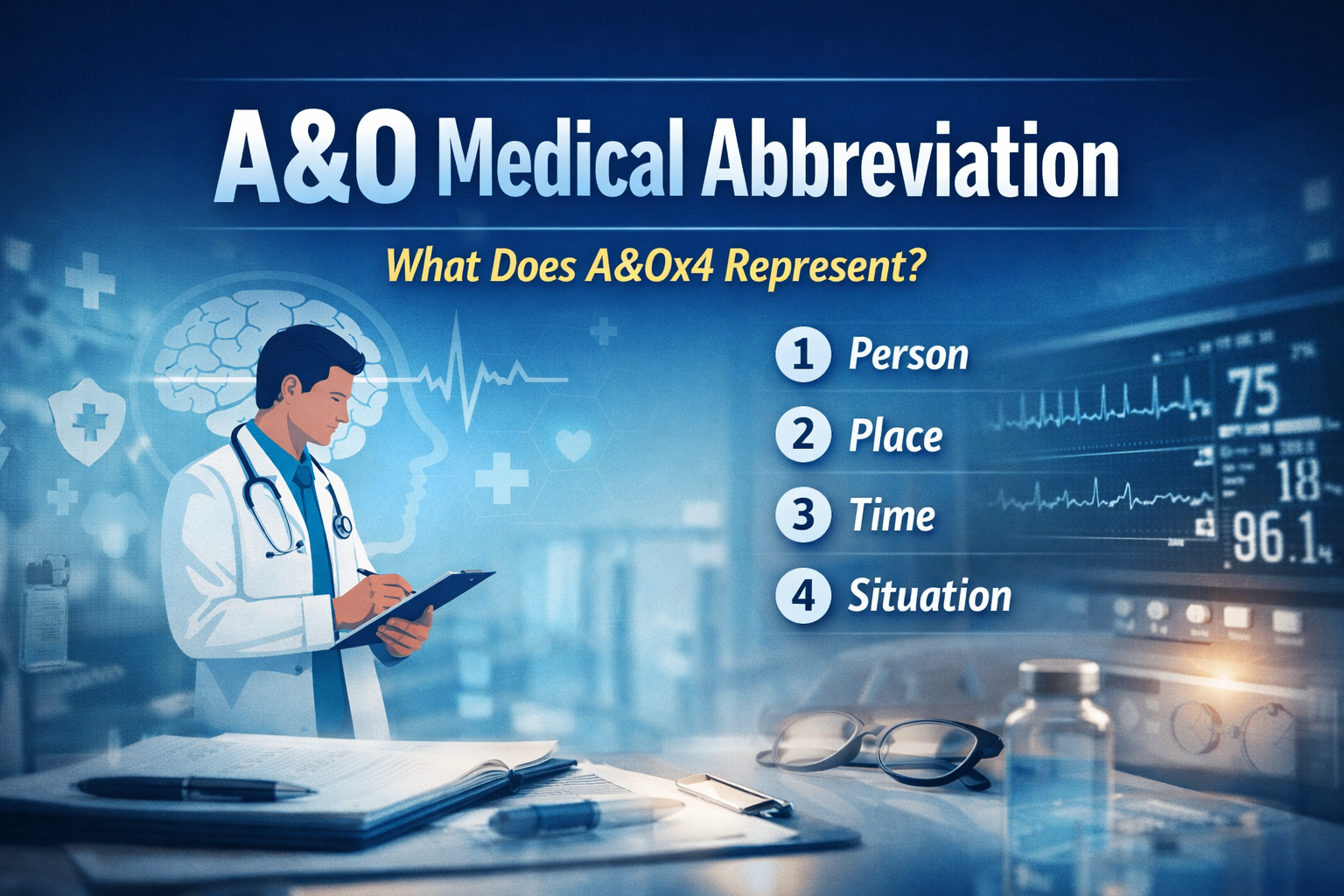
What Does A&Ox4 Represent?
Authoritative educational sources also describe the four domains of orientation in this extended format:
- Person — awareness of one’s identity
- Place — awareness of the current location
- Time — awareness of date or time context
- Situation (or Event) — awareness of the surrounding circumstances
🔗 Welly Health – A&O Assessment Explanation
Note: The fourth orientation domain may be documented differently across institutions, often described as “situation,” “event,” or similar contextual awareness.
Why Is Understanding A&O Important for Researchers and Students?
For academic researchers and students engaging with clinical literature, understanding shorthand like A&O and its extensions is necessary for accurate interpretation of source materials. This terminology appears in case reports, documentation guides, and clinical protocols, and should be read within its descriptive documentation context.
Explore More with PubMed.ai
If you want to quickly search, summarize, and organize biomedical literature, PubMed.ai is an invaluable tool. From extracting key study insights to generating structured research reports, PubMed.ai helps clinicians, researchers, and students save time while maintaining accuracy. Learn more at PubMed.ai.
Disclaimer:
This AI-assisted content is intended for academic reference and informational purposes only and does not constitute medical advice, diagnosis, or treatment. Always consult qualified healthcare professionals regarding any medical condition or treatment decisions. All risks arising from reliance on this content are borne by the user, and the publisher assumes no responsibility for any decisions or actions taken.

Have a question about biomedical research or published clinical studies? PubMed.ai helps you explore published biomedical literature with AI assistance.
Subscribe to our free Newsletter